
Change initiatives fail. A lot.
In fact, studies show that up to 70% of organizational change efforts don’t achieve their intended goals. Why is this happening, despite huge investments in training, technology, and consultants?
The answer lies in a hidden obstacle: what I call the “Psychological Impasse to Change.” This isn’t about resistance to change itself; it’s about a deeper, often unconscious set of barriers that prevent organizations from truly tapping into the potential of their employees.
A Self-Reinforcing Cycle
The Psychological Impasse to Change is a self-reinforcing cycle driven by three key forces:
- Executive Skepticism: Leaders often underestimate the ability of frontline workers to contribute meaningful solutions. They may claim to value employee input, but their actions (or inactions) reveal a lack of trust.
- Middle Management Overload: Middle managers are frequently caught between top-down directives and the day-to-day realities of managing their teams. They’re often overwhelmed and lack the time or resources to genuinely support employee-driven change.
- Frontline Cynicism: Employees, having experienced countless “engagement” initiatives that led to no real change, become understandably cynical. They see “input” requests as a waste of time, believing that leadership only wants compliance, not genuine contribution.
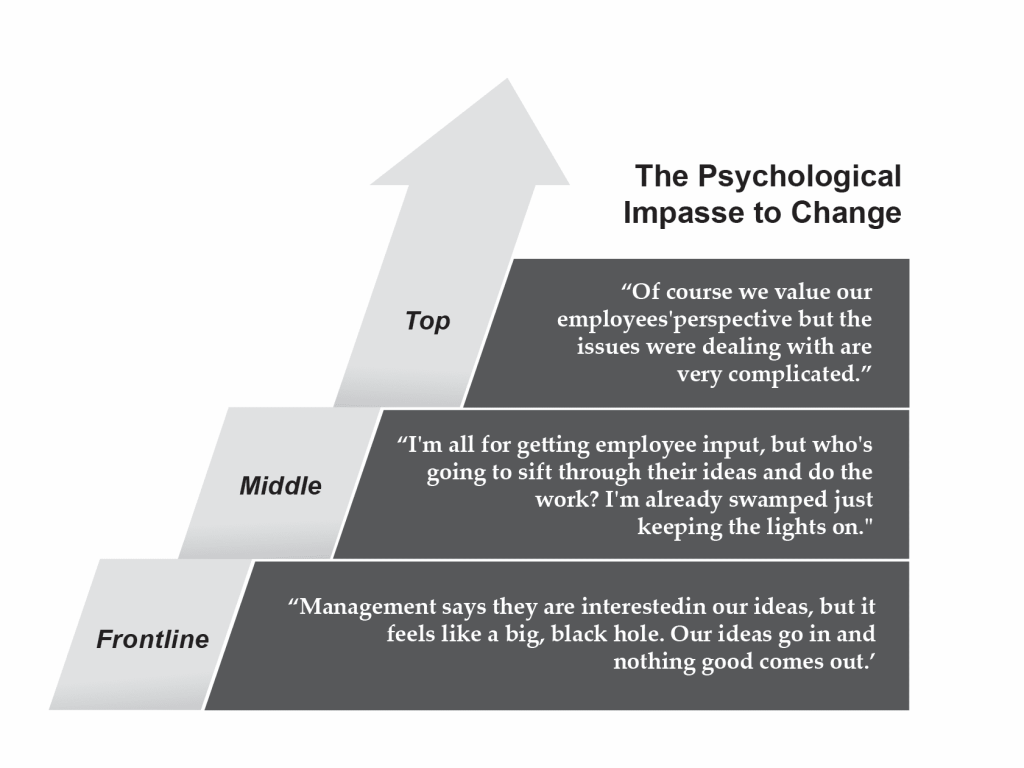
This vicious cycle hardens attitudes and behaviors: Leaders don’t fully trust employees, so they implement superficial engagement programs. These programs produce poor results, reinforcing the leaders’ skepticism. Employees, feeling unheard and undervalued, become even more disengaged, further solidifying the impasse.
The consequences of this Psychological Impasse extend far beyond failed change initiatives to:
- Missed Opportunities: Countless valuable insights and ideas from the people closest to the work go untapped.
- Disengagement and “Quiet Quitting”: Employees mentally check out, doing the minimum required.
- Stagnation: Innovation grinds to a halt.
- Wasted Resources: Billions are spent on ineffective programs and initiatives.
Beyond the “Persuasion Trap” and the “Illusion of Engagement”
Many leaders mistakenly believe the remedy for slow or stalled initiatives and lackluster response from below, lies in more communication—believing that if they just communicate the “why” of change effectively and often enough, employees will embrace it. But it’s a dead end, a “Persuasion Trap”. Frontline employees don’t need more presentations to get fired up for change; they need real opportunities to shape it.
Conventional approaches to change management—from town halls to crowdsourcing of ideas—are not sufficient to break this deadlock. At best, they create the Illusion of Engagement, a short-lived “sugar-high” that doesn’t last because employees never get beyond being passengers invited on the train versus drivers to the destination.
The Missing Element: Ownership and Practical Tools
As Tom Peters famously quipped, “No one ever washes a rental car before returning it!” Just so, when employees feel a sense of ownership over their work, they’re more likely to be engaged, motivated, and committed to achieving results—instead of operating as merely renters along for the ride.
But ownership alone isn’t enough. Employees also need the tools and the authority to act on their ideas. They need a framework that empowers them to move from insight to action, quickly and effectively.
Breaking Through with the Ideas-to-Action Process
The Ideas-to-Action Process, detailed in my new book, is specifically designed to help organizations break through the Psychological Impasse to Change. It’s about creating a system where:
- Leaders demonstrate genuine trust in their employees’ capabilities.
- Middle managers are equipped to support employee-driven change, not burdened by it.
- Frontline employees are effectively empowered to take ownership of solutions and drive real results.
- Employee engagement efforts are directly aligned with strategic goals.
- There’s a clear process for capturing, evaluating, prioritizing, and implementing employee ideas.
It requires moving beyond persuasion and “engagement for engagement’s sake” to creating a culture of effective employee-powered innovation.
Are you recognizing the signs of the Psychological Impasse to Change in your own organization? It’s a common challenge, but it can be overcome with the right mindset and the right framework.